

Bill of Sale Explained: Your Guide to Vehicle Title & Registration
Learn what a bill of sale is, how it relates to vehicle titles, and how J.G. Title Company can simplify your DMV process.
What Is a Bill of Sale and Why Does It Matter?
When buying or selling a vehicle, the bill of sale is a crucial document that acts as proof of the transaction. It details the transfer of ownership from the seller to the buyer and is often required by the Department of Motor Vehicles (DMV) to process the vehicle title and registration.
Understanding the bill of sale is essential for drivers, dealers, and lienholders alike. It ensures legal compliance, protects both parties, and helps avoid confusion or delays at the DMV.
In this guide, we’ll explore what a bill of sale is, how it fits into the vehicle title and registration process, and how J.G. Title Company’s streamlined platform can help you avoid the hassle of DMV visits.
What Exactly Is a Bill of Sale?
A bill of sale is a legal document that records the sale of a vehicle. It typically includes:
Buyer and seller information (names, addresses)
Vehicle details (make, model, year, VIN)
Sale price and date of transaction
Signatures of both parties
Why Is It Important?
Proof of Ownership Transfer: It confirms that the seller has transferred ownership to the buyer.
Legal Protection: Helps resolve disputes over ownership or payment.
DMV Requirement: Many states require a bill of sale to process title transfers and registrations.
How Does a Bill of Sale Relate to Vehicle Titles?
The vehicle title is the official document issued by the state that proves legal ownership of the vehicle. While the bill of sale shows the transaction, the title legally transfers ownership.
Key Differences:
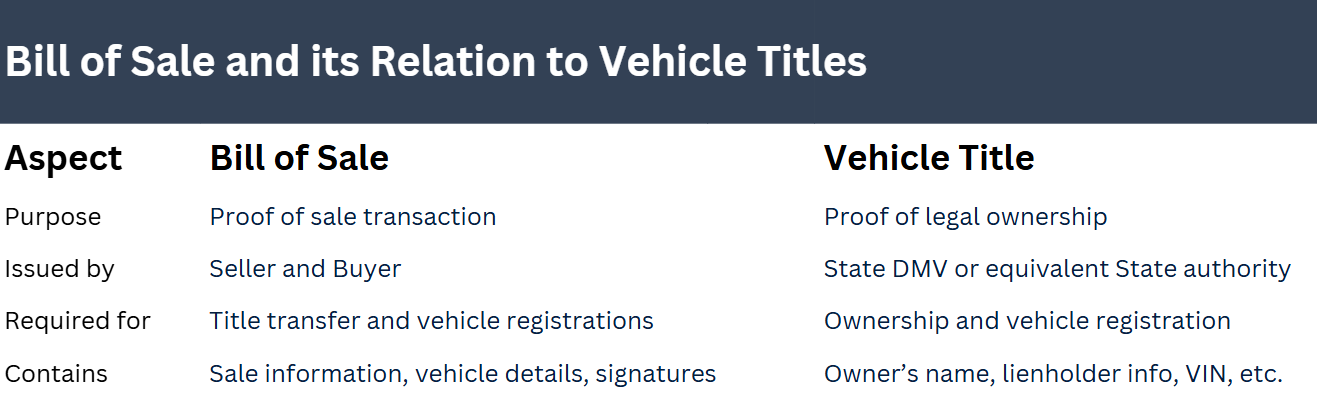
In most cases, after completing the bill of sale, the buyer must submit it along with the title to the DMV to finalize the ownership transfer.
How to Fill Out a Bill of Sale Correctly
Filling out a bill of sale properly is critical to avoid delays or legal issues. Here’s a step-by-step guide:
Step 1: Gather Vehicle Information
Collect the vehicle’s make, model, year, VIN, and odometer reading.
Step 2: Include Buyer and Seller Details
Full legal names and addresses of both parties.
Step 3: Specify the Sale Price and Date
Clearly state the amount paid and the date of sale.
Step 4: Add Any Conditions or Disclosures
Note if the vehicle is sold “as-is” or if there are any warranties.
Step 5: Sign and Date the Document
Both buyer and seller must sign and date the bill of sale.
Step 6: Make Copies
Each party should keep a copy for their records.
State Variations and Legal Considerations
Every state and county may have different requirements for bills of sale and title transfers. Some common variations include:
Notarization:Some states require notarized bills of sale.
Additional Forms:Certain states require supplementary forms or affidavits.
Fees:Title transfer and registration fees vary widely.
Lienholder Information:If there is a lien on the vehicle, additional documentation may be needed.
Tip: Always check your state’s DMV website or consult with a title service provider to ensure compliance.
Common Challenges with Bill of Sale and Title Transfers
Many vehicle owners face issues such as:
Lost or incomplete bills of sale
Confusing DMV requirements
Long wait times at DMV offices
Errors in paperwork causing delays
These challenges can lead to frustration, fines, or even legal complications.
How J.G. Title Company Simplifies the Process
At J.G. Title Company, we understand the complexities of vehicle title and registration processes. Our mostly online platform offers:
Expert Title Processing: Our trained staff handle paperwork accurately.
Lien Filing and Tax Quotes: We manage lienholder filings and provide tax estimates.
Duplicate Titles and Registration Renewals: Fast, reliable service across all 50 states and Tribal Lands.
Avoid DMV Visits: Save time and avoid confusion by letting us do the work for you.
Why Choose Us?
Compliance with state-specific regulations
Streamlined, technology-driven process
Reliable and secure handling of your documents
Nationwide coverage with local expertise
Alternatives to Traditional Bill of Sale Handling
While the traditional bill of sale process is necessary, J.G. Title Company offers a third option:
Online Submission: Upload your documents securely.
Professional Review: We verify and complete forms to avoid errors.
Direct DMV Filing: We submit paperwork on your behalf.
Status Updates: Track your title or registration progress online.
This approach reduces errors, speeds up processing, and provides peace of mind.
Conclusion: Understanding Your Bill of Sale and Next Steps
A bill of sale is a foundational document in vehicle ownership transfer, but navigating the title and registration process can be complex and time-consuming. Whether you’re a private buyer, dealer, or lienholder, understanding the bill of sale’s role is key to a smooth transaction.
If you want to avoid long DMV lines, paperwork confusion, and potential delays, consider using J.G. Title Company’s expert services. Our platform is designed to make your vehicle title and registration experience simple, fast, and compliant.
Ready to simplify your vehicle title process? Contact J.G. Title Company today and let us handle the hard work for you.