

Does a Bill of Sale Need to Be Notarized
Does a Bill of Sale Need to Be Notarized? State Rules & Expert Tips
Discover when a bill of sale must be notarized for vehicle sales. Learn state-specific rules, legal tips, and how J.G. Title Company simplifies your title transfer.
Introduction
If you’re buying or selling a vehicle, you’ve likely asked yourself: does a bill of sale need to be notarized? This question is common but tricky because notarization requirements vary widely depending on the state, type of vehicle, and transaction details. Understanding when notarization is necessary can protect you from legal issues, speed up your title transfer, and ensure your transaction is valid.
In this comprehensive guide, we’ll explain the purpose of notarizing a bill of sale, explore state-by-state differences, and show you how J.G. Title Company’s streamlined online platform can help you avoid DMV headaches while ensuring compliance.
What Is a Bill of Sale and Why Is It Important?
A bill of sale is a legal document that records the transfer of ownership of a vehicle from the seller to the buyer. It typically includes:
Vehicle details (make, model, year, VIN)
Sale price and date
Buyer and seller names and addresses
Signatures of both parties
Why You Need a Bill of Sale
Proof of ownership transfer: It legally documents the sale.
DMV requirement: Most states require it to register or title a vehicle.
Tax calculation: Helps determine sales or use tax owed.
Does a Bill of Sale Need to Be Notarized?
The short answer is: it depends. Whether a bill of sale must be notarized varies by:
State laws: Some states mandate notarization for vehicle sales; others do not.
Vehicle type: Requirements may differ for cars, boats, RVs, or motorcycles.
Transaction type: Private sales often have different rules than dealer sales.
State-by-State Notarization Requirements for Bills of Sale
States That Usually Require Notarization
Texas: Notarization is mandatory for private vehicle sales.
Florida: Certain vehicle sales require notarized bills of sale.
Louisiana: Bill of sale must be notarized for title transfer.
Arkansas: Notarization is required in many cases.
States That Typically Do Not Require Notarization
California: Bill of sale required, notarization optional.
Pennsylvania: Notarization generally not required.
Missouri: Notarization is optional but recommended.
How to Verify Your State’s Rules
Check your state DMV website.
Contact your local DMV or title agency.
Consult legal resources or trusted title service providers.
Why Do Some States Require Notarization?
Notarization adds legal protection by:
Verifying the identities of buyer and seller.
Preventing fraud by authenticating signatures.
Making the document legally binding and easier to enforce.
How to Notarize a Bill of Sale
If your state requires notarization, follow these steps:
Prepare the bill of sale: Complete all required fields.
Do not sign yet: Both parties must sign in front of the notary.
Find a notary public: Available at banks, law offices, or DMV offices, and in some cases J.G. Title Company
Bring valid ID: Government-issued IDs for all signers.
Sign in front of the notary: The notary witnesses signatures.
Receive notarized document: The notary affixes their seal and signature.
Consequences of Not Notarizing When Required
Failing to notarize a bill of sale when your state requires it can cause:
Delays or rejection of your title transfer.
Legal disputes over vehicle ownership.
Possible fines or penalties.
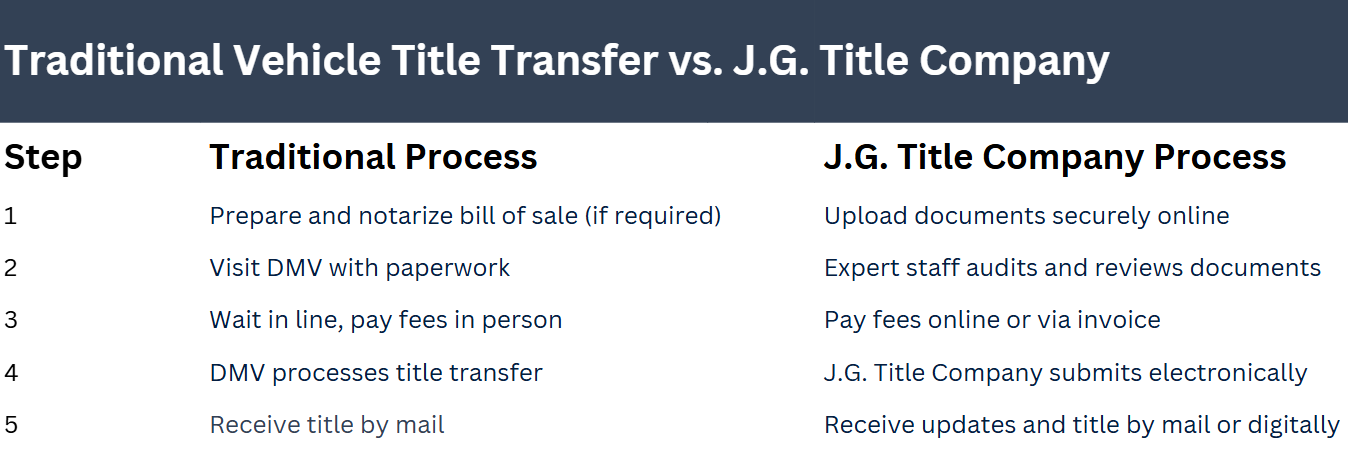
How J.G. Title Company Can Help You
J.G. Title Company offers a mostly online platform that simplifies vehicle title transfers and registrations nationwide, including Tribal Lands. Our services include:
Title processing and registration across all 50 states.
Lien filings and tax quotes.
Document auditing to ensure compliance with notarization and other legal requirements.
Avoiding long DMV wait times by letting trained professionals handle your paperwork.
Benefits of Using J.G. Title Company
Expertise: Knowledge of state-specific notarization and title laws.
Convenience: Submit documents online without visiting the DMV.
Speed: Faster processing times, often within days to weeks.
Reliability: Inspired by ISO 9001 quality management for accuracy.
Frequently Asked Questions (FAQs)
1. Does a bill of sale always need to be notarized?
No. Notarization depends on your state’s laws and the type of vehicle transaction.
2. Can I notarize a bill of sale online?
Some states allow online notarization, but many require in-person notarization.
3. What if I lost my notarized bill of sale?
You may need to request a duplicate or affidavit from your DMV or title service provider.
4. Is a bill of sale required to register a vehicle?
Yes, most states require a bill of sale or similar proof of purchase for registration.
5. How does J.G. Title Company assist with notarization and title transfers?
We audit your documents, ensure legal compliance, and handle DMV submissions to simplify the process.
Conclusion: Understanding When a Bill of Sale Needs to Be Notarized Protects Your Vehicle Transaction
Knowing whether a bill of sale needs to be notarized is essential to avoid delays and legal issues in vehicle sales. Because requirements vary by state and transaction type, always verify your local rules before completing your sale.
If you want to avoid confusing paperwork and long DMV lines, J.G. Title Company’s expert online platform can help. We ensure your documents meet all legal requirements—including notarization when necessary—so you can transfer your vehicle title quickly and confidently.
Ready to simplify your vehicle title transfer?
Contact J.G. Title Company today or start your process online to save time and avoid DMV hassles.