

How to Transfer a Car Title When Owner Is Deceased | Step-by-Step Guide
Learn how to transfer a car title when the owner is deceased with our detailed, state-specific guide. Avoid DMV hassles with expert tips and J.G. Title Company’s service.
Introduction
Losing a loved one is difficult, and dealing with their vehicle title transfer can add to the stress. If you’re wondering how to transfer a car title when owner is deceased, you’re not alone. This process involves legal and DMV procedures that vary by state and can be confusing without the right guidance.
In this comprehensive guide, we’ll walk you through the traditional steps to transfer a vehicle title after the owner’s death, explain the legal requirements, and introduce a streamlined alternative through J.G. Title Company’s mostly online platform. Whether you’re a family member, executor, or lienholder, this article will help you navigate the process efficiently and avoid common pitfalls.
Understanding Vehicle Title Transfer After Death
What Happens to a Vehicle Title When the Owner Dies?
When a vehicle owner passes away, the title does not automatically transfer to the heir or beneficiary. Instead, the title must be legally transferred through the DMV or relevant state agency, often requiring probate or estate documentation.
Why Is This Process Different?
Unlike a regular title transfer, transferring a title from a deceased owner involves:
Verifying legal ownership through wills or probate court
Submitting additional documents like death certificates and estate paperwork
Complying with state-specific laws and timelines
Step-by-Step Guide: How to Transfer a Car Title When Owner Is Deceased
Step 1: Gather Required Documents
Before starting the transfer, collect these essential documents:
Original vehicle title (if available)
Certified copy of the owner’s death certificate
Proof of your legal authority (e.g., will, letters testamentary, or small estate affidavit)
Valid government-issued ID
Completed title transfer application form (varies by state)
Odometer disclosure statement (if applicable)
Payment for title transfer fees and taxes
Step 2: Determine the Legal Authority to Transfer
You must prove you have the legal right to transfer the title. This usually means:
Being named executor or administrator of the estate
Having power of attorney or legal guardianship
Using a small estate affidavit if the estate qualifies
Step 3: Complete the Title Transfer Application
Each state has its own form for title transfer. You can usually find these on your state’s DMV website. Fill out the form carefully, including:
Vehicle details (VIN, make, model, year)
Your information as the new owner
Deceased owner’s information
Step 4: Submit Documents to the DMV or County Office
Submit all paperwork in person or by mail, depending on your state’s rules. Some states allow online submissions or have specific offices for estate-related title transfers.
Step 5: Pay Fees and Taxes
Title transfer fees and taxes vary by state and sometimes by county. Be prepared to pay:
Title transfer fee
Sales tax (if applicable)
Any outstanding registration fees
Step 6: Receive the New Title
Once processed, the DMV will issue a new title in the name of the heir, beneficiary, or estate representative.
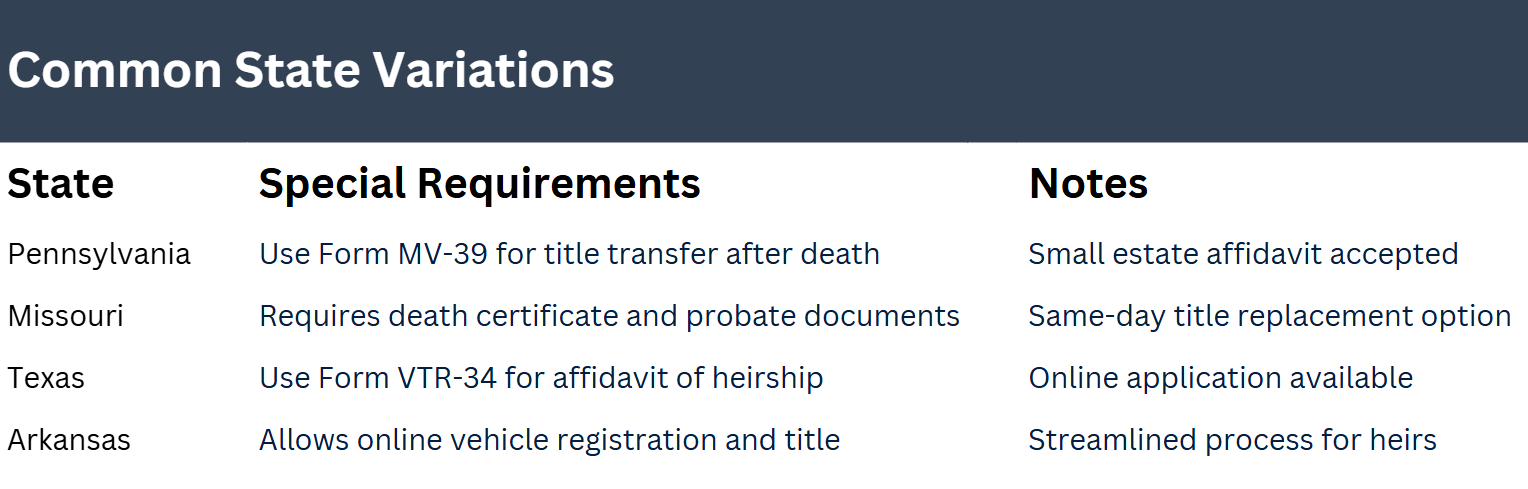
State-Specific Considerations
Probate vs. Non-Probate Transfers
Probate Required: If the vehicle is part of a large estate, probate court approval may be necessary before transfer.
Non-Probate Transfers: Some states allow simplified transfers using affidavits or small estate procedures if the vehicle’s value is below a threshold.
Challenges and How to Avoid Them
Common Issues
Missing or incomplete documents
Confusion over legal authority
Delays due to probate or DMV backlogs
Incorrect or outdated forms
Tips for a Smooth Transfer
Verify all documents before submission
Contact your state DMV for specific instructions
Keep copies of everything submitted
Consider professional help if probate is involved
J.G. Title Company’s Streamlined Solution
Transferring a car title after the owner’s death can be time-consuming and confusing. J.G. Title Company offers a mostly online platform that simplifies this process by:
Handling paperwork and DMV interactions on your behalf
Providing expert guidance tailored to your state and situation
Reducing wait times and errors with our technology-driven approach
Offering support for lien filings, registrations, and tax quotes
This service is ideal for individuals who want to avoid long DMV lines and complicated legal procedures while ensuring compliance and accuracy.
Frequently Asked Questions (FAQs)
1. Can I transfer a car title if the owner died without a will?
Yes, but the process may require probate court approval or a small estate affidavit depending on your state’s laws.
2. How long does it take to transfer a title after the owner’s death?
It varies by state and complexity but typically ranges from a few days to several weeks.
3. What if the original title is lost?
You can apply for a duplicate title before or during the transfer process.
4. Do I need to pay taxes when transferring a deceased owner’s vehicle title?
Most states require payment of sales or transfer taxes unless the transfer is to a spouse or heir under specific exemptions.
5. Can J.G. Title Company help with out-of-state title transfers after death?
Yes, we provide nationwide service across all 50 states and Tribal Lands.
Conclusion
Knowing how to transfer a car title when owner is deceased is crucial to managing a loved one’s estate smoothly. While the traditional process involves multiple steps, legal documents, and state-specific rules, J.G. Title Company offers a modern, efficient alternative that saves time and reduces stress.
If you’re ready to simplify your vehicle title transfer after a loved one’s passing, contact J.G. Title Company today. Let our experts handle the complexities so you can focus on what matters most.